

A new NASA-led study shows that the growing number of satellites in low Earth orbit could ruin up to 96% of images from some orbiting telescopes and space observatories.
“The urgency begins at the moment when we are seeing a very rapid increase in the number of satellite constellations, in particular, not the satellites that have been launched, but the satellites that are being proposed,” Dr. Alejandro Serrano Borlaff, a research scientist at NASA Ames Research Center and co-author of the study, told ABC News. “Before these satellites come online, we need to determine what the consequences would be for the telescopes and if there is a way to mitigate any problems.”
Satellites reflect sunlight, Earthshine, infrared and radio waves. The study found that some of that reflected sunlight can create bright streaks that can obscure cosmic images, including one. Image from the Hubble Space Telescope of interacting galaxies. Researchers refer to those streaks as satellite trails, which are not visible to the naked eye.

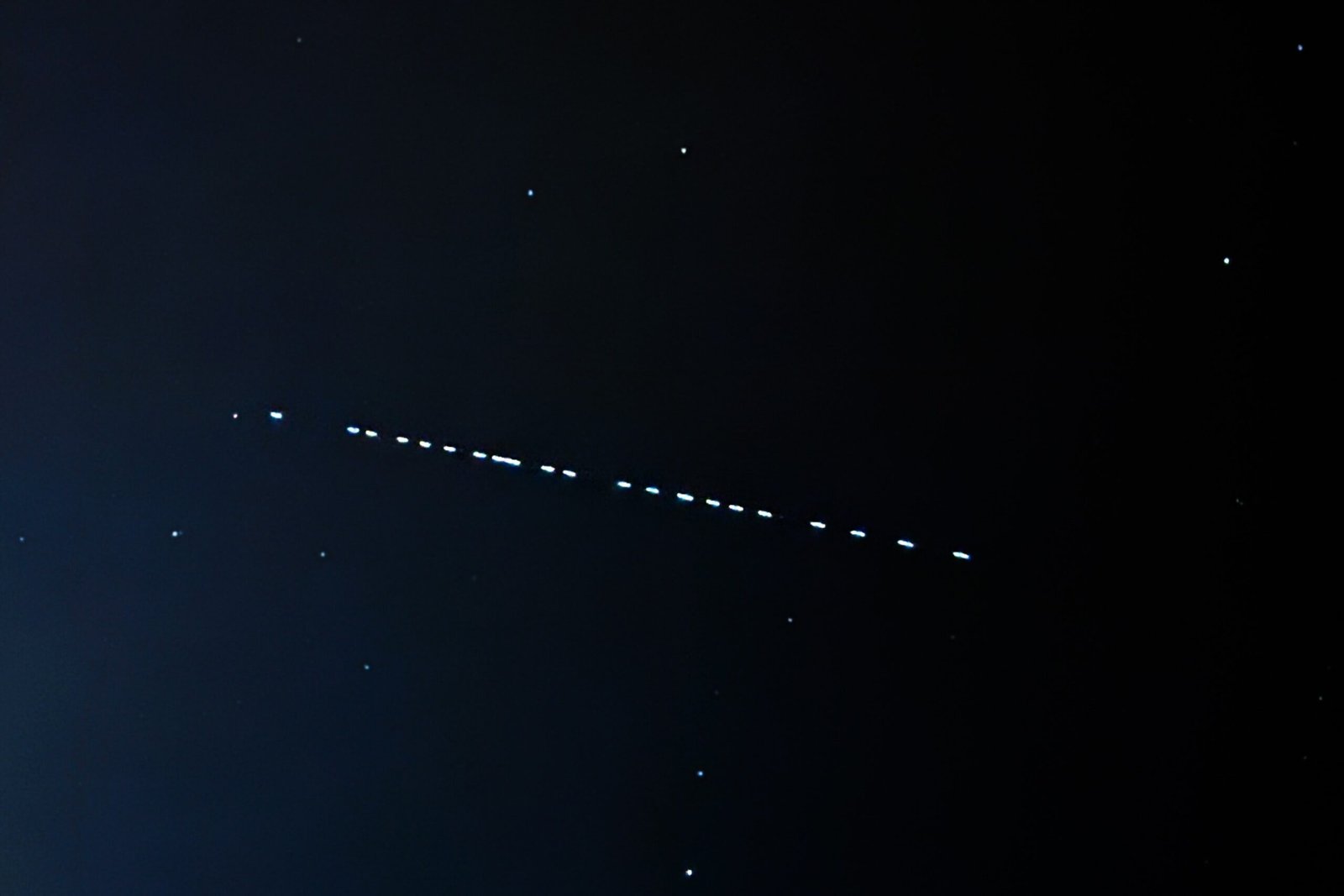
The passing of the Starlink satellites is seen in the sky over southern Poland on November 1, 2024.
Jakub Porzycki/NurPhoto via Getty Images
Scientists at NASA Ames Research Center discovered that these traces affect not only observatories here on Earth but also those in space. The study found that almost a third of Hubble exposures will show contamination from satellite traces.
To understand the magnitude of the problem, the researchers simulated about 18 months of telescope observations under the assumption that low-Earth orbit would be populated by 560,000 satellites, a situation that could emerge in the next decade. Under these conditions, they found that the satellite streaks would interfere with between 40% and more than 96% of the images taken by the main observatories.
Data shows that the number of satellites in low Earth orbit has increased from about 2,000 in 2019 to 15,000 in 2025.
“As we launch more satellites into space, the space for telescopes and astronomy in general becomes increasingly narrower,” Borlaff said.
The researchers found that three of the four telescopes studied could see up to 96% of their images altered by satellite streaks. That includes NASA’s SPHEREx, which launched in March, as well as China’s upcoming Xuntian observatory and ESA’s ARRAKHIS mission, both still on the ground.

This document obtained on December 3, 2025 from NASA shows an image that simulates how satellite lights contaminate images of the universe taken by space telescopes. Light from half a million satellites that humanity plans to launch into Earth’s orbit in the coming years could contaminate almost all images taken by space telescopes, NASA astronomers have warned.
NASA/AFP via Getty Images
NASA’s latest finding highlights a growing tension between expanding satellite networks and the ability of space telescopes to study distant galaxies, planets and other key astronomical targets.
“We need to find a way to coexist,” Borlaff said.
A common misconception is that scientists can simply “fix” satellite footprints. “Sure, you can do it,” Borlaff emphasized, but every time you change an image, in this case to remove a satellite trail, “the information beneath those pixels is lost forever.” In a more congested low-Earth orbit, lost information accumulates and some of it can never be recovered.
Other proposed solutions carry serious trade-offs. Pointing telescopes vertically can avoid some traffic, but researchers can’t always do so without missing their targets or straining the instruments. Furthermore, redesigning the entire space ecosystem by elevating satellites or moving telescopes further away is costly and risky, as it exposes observatories to more intense radiation.
